Hackers target politicians with fake news website
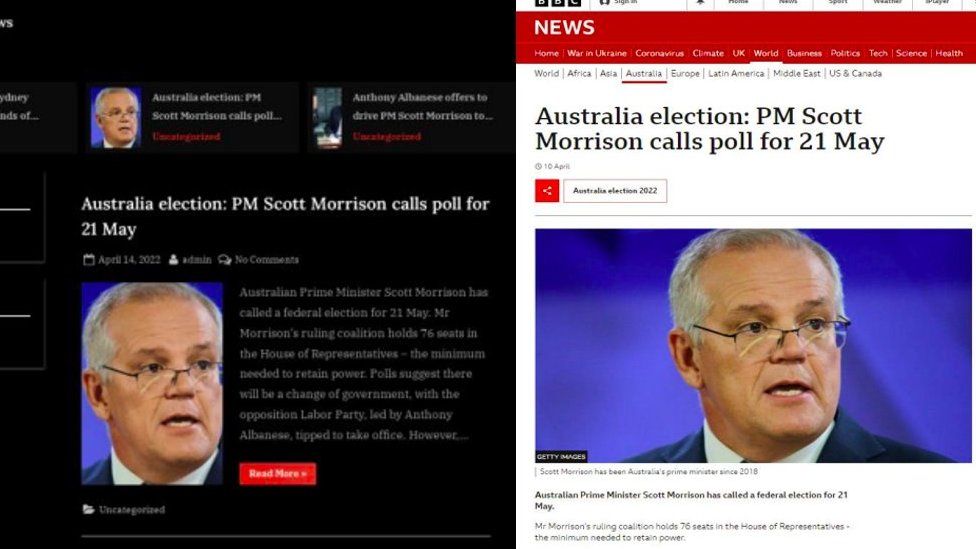
Programmers made a phony news site to collect information from Australian government authorities, writers and others, as indicated by a top US security organization.
The objectives got messages professing to be from Australian media sources, which connected them to a vindictive site.
The site, populated with articles taken from BBC News, would then introduce vindictive code on their gadget.
Proofpoint said it had "high certainty" the programmers were lined up with the Chinese government.
"We view attribution exceptionally in a serious way," Proofpoint danger exploration and identification VP Sherrod DeGrippo said.
"We explicitly don't deliver attribution except if we have high certainty.
"Basically, a major piece of our attribution capacity comes from the way that the United States Department of Justice concurs with the attribution and information that we have delivered.
"The explanation that we have such high trust in this specific attribution truly returns to the DoJ arraignment, which makes reference to these respondents and explicitly gets down on the Proofpoint name identifier of 'Leviathan'."
'Reconnaissance persuaded danger'
Proofpoint said the programmers were important for a gathering of which four individuals had been charged by the US in 2021, when the UK's National Cyber Security Center said it was "practically 100%" they were connected to the Chinese government.
It said the gathering was "a China-based, surveillance persuaded danger entertainer that has been dynamic starting around 2013, focusing on various associations because of political occasions in the Asia-Pacific district, with an emphasis on the South China Sea."
The Australian Cyber Security Center has been drawn nearer for input.
In the gathering's most recent hack, among April and June, casualties had gotten messages professing to be from somebody who had begun a news site, Proofpoint said.
They had then been approached to survey the site and think about composition for it.
'Old English styled names'
"My thought process is very original about it is they ventured to such an extreme as to make these phony media sites, by scratching genuine locales, including the BBC, in their endeavors to show up genuine," Ms DeGrippo said.
"Also, further, they made numerous characters that they were sending from.
"There's around 50 of them... all of the very Anglo-styled names you could envision Australians to be named.
"They made such pseudo personalities to send off the assault from, making them more trustworthy."
The phony names - each with their own novel Gmail address - included Daisha Manalo, Blair Goodland, and Bethel Giffen.
Casualties were welcome to compose for another news site, which was phony
The phony site was loaded up with malware that would contaminate the casualty's PC with an instrument called Scanbox, checking their profile, gadget and pages visited.
"Scanbox basically is a web surveillance and double-dealing structure," Ms DeGrippo said.
"At the point when that's what we contemplate, related to the entertainer who is a China-based reconnaissance bunch, it seems OK."
'Delicate job'
The assault appeared to zero in on individuals engaged with energy creation, for example, seaward energy investigation in the South China Sea, wind-turbine assembling and elective energy yet additionally safeguard project workers and people associated with medical care and monetary administrations.
"Customers by and large are not on the radar of Chinese secret activities administrations," Ms DeGrippo said.
"Nonetheless, any individual who plays a delicate part inside their expert work, regardless of whether they're managing things, for example, designing, things that probably won't seem like state privileged insights... actually China considers them to be privileged insights and as significant undercover work data."
Individuals ought to guarantee their programs were refreshed and firewall and antivirus programming turned on, Ms DeGrippo said.
Yet, she added: "Associations expertly should contemplate the sorts of information that their workers approach and assuming they have the right mechanical means set up to safeguard their representatives from these sorts of assaults.
"When it gets to a human, it's actually past the point of no return."
Comments
Post a Comment